

I recently invested in a PlayStation Portable 1001, trying to relive the glory days of late 2000s. I was immediately reminded that the chocolate bar shaped console was unsuitable for adults with big hands. My hands are pins and needles after ten minutes of play.
I had a list of games that I always wanted to try, and decided it was time to live out my twenties one more time. I went for Resistance Retribution, 3rd Birthday, SOCOM Fire Team 2, Coded Arms, and Syphon Filter. These were dead franchises for the PlayStation and I miss them very much.
PlayStation Portable is an enigma. It has a controller with a single analog nub, graphics between Dreamcast and PS2, and one of the most ambitious game libraries outside the Nintendo DS. Despite its analog limitations, the 3D shooter genre was vibrant. But looking back, there is not a single PSP shooter that deserves to be remade (at least with the same control scheme). These games have aiming and movement flaws galore, but that makes them so charming. Here is why I decided to suffer through PSP shooters.
AUTO-AIMING:
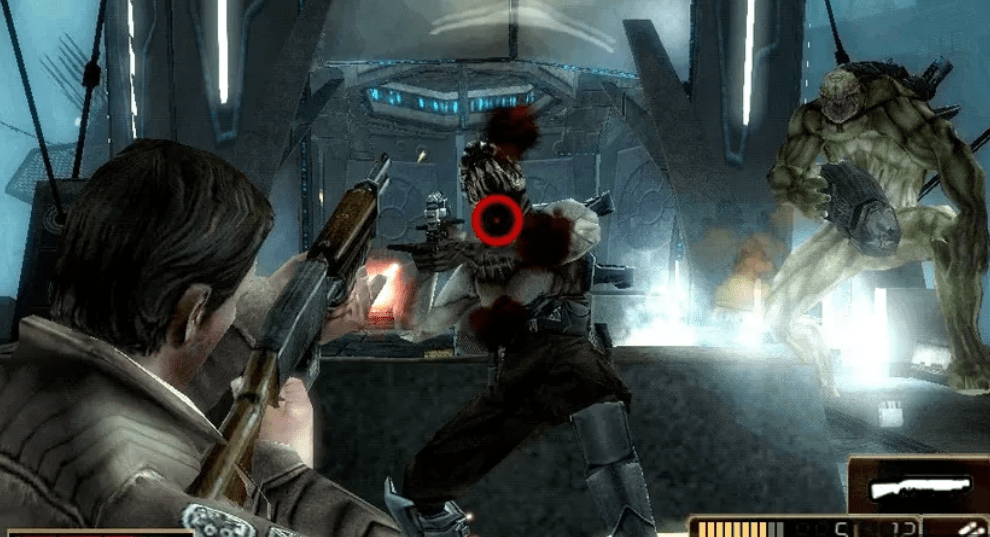
A major gameplay quirk that makes shooters even possible on consoles is auto-aiming. Without auto-aiming, trying to move your cursor on specific parts of an enemy would be a nightmare. Resistance Retribution has it on by default, and the game is impossible without it. There are levels where hundreds of bugs attack you, and trying to aim at them is a complete nightmare. SOCOM FT2 has two very weird aiming choices. You either need to auto-aim, which allows your player to shoot at anything miles away, or you have to stand still to free aim and zoom in on enemies. It’s bizarre, but it changes how you enjoy the difficulty.
Auto-aim is glitchy sometimes. In 3rd Birthday, your character will aim at the enemy behind the one chasing you. This becomes a swear fest in hectic boss fights. Though you might curse the day God gave you fingers, you can appreciate that this gaming limitation is using different parts of your brain.
THE D-PAD:
To make shooter games even more inconvenient, the PSP opted out of L2 and R2 triggers. All adjustments you need to make to your player are done on the D-pad. That means you have to take your finger off the analog stick to change weapons, crouch, press buttons, and activate special attacks. The PlayStation One and N64 found ways around this inconvenience, but the PSP embraced it. Imagine running through gunfire on the battlefield, but you have to take your hand off the movement to push a button or change weapons. No self-respecting game company should ask you to do this, but the PSP made it the Golden Rule for all their shooter games.
FACE BUTTON LOOK:
When faced with free look on the DS, many games require the stylus to move the camera. The PSP did not have that luxury so all camera movements were relegated to the face buttons (which I prefer over the stylus). Moving the camera with X, O, [], and triangle is a horrific strain on your thumbs, but it makes headshots and sniper shots that much more rewarding. And since the camera moves like a tank, the challenges and bosses need to be adjusted so they don’t destroy you instantly. Although some games do have bosses that unfairly destroy you over and over. There is a giant flying alien boss in Resistance that flies around much faster than your character can look, adding some very cheap deaths. I have arthritis forever, but I eventually beat that turd.
All evidence points to these gaming experiences being a slog, but the humble limitations of the PSP controller design add a silly charm and nostalgia that I am glad I get to relive. Naturally, my blood pressure is very high trying to beat these games, but that is another issue.
 The Checkpoint Blog