
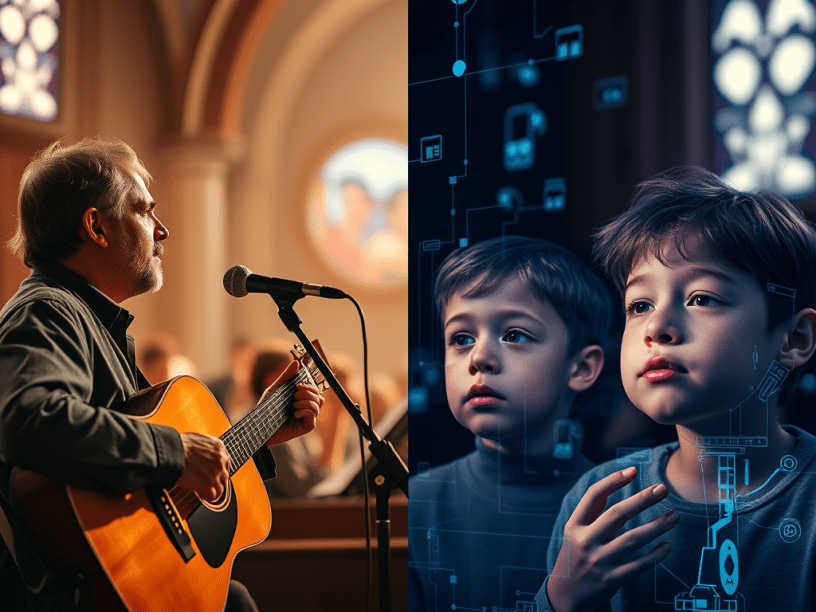
AI has been exploding since ChatGPT, CoPilot, and Midjourney shared their brilliant robots with the world. Now, any average (and very untalented) Joe can produce things that look semi-professional.
Recently, I looked up some kids’ worship Songs, and I found a video where all the footage is AI-generated, and the song was produced through an AI system. The well-meaning producer aimed to create a flashy presentation that would appeal to kids, accompanied by a catchy tune. I am unsure if they paid for the premium AI, as the video depicted children with nightmarish, shifting, and deformed faces, and their fingers constantly changed shape. If you don’t mind soulless, dead stares from smiling kids and a song that sounds more processed than a hot dog, then you probably don’t care about worship quality all that much. Here it is…sweet dreams.
This begs the question, “Should the church jump on the AI bandwagon?” It’s the wave of the future, enabling the user to produce art of Pixar quality without even picking up a drawing tablet. Musicians would no longer need to pick up guitars or microphones to create new hits. For the past week, I have been feeding my old worship poems into a lyrics-into-song generator, and now all my words sound like bangers from Creed, Chevelle, and Trace Adkins (albeit their lesser tracks). Here are some key ethical considerations to keep in mind when deciding on an approach.
Does God deserve effortless art?
AI reduces labor, measuring, brainstorming, and puzzle solving to mere written commands. This makes producing things a whole lot easier. YouTube and Kindle have already found a way to monetize this by letting AI write the books and create the videos.
One component of worship that matters to God is the effort and labor involved in producing the media. If he wanted good-to-great songs pumped out 24/7, he would just ask his heavenly choir to go at it (which they do). But the added bonus of being a free-willed human is that you get to strive to show God your appreciation. AI is not striving. That is why AI exists: to bypass the tedious work and produce passable products. Therefore, worship that is created by the will and brain of a computer has little to no effort in it. Maybe the code writers for AI are praising God for making the AI programs, but the musician or artist is not.
David demonstrates the appropriate effort for genuine worship when he insists on paying Araunah the full price of his farm land to build the temple. Araunah offers to give it for free (a perk of being a king). Still, David says, “I will buy them from you at full[c] price. I won’t offer to the Lord my God burnt offerings that cost me nothing.” (2nd Samuel 24:24). We definitely need to be careful when we offer God things that cost us nothing.
In most cases, people like me cannot produce music at all. I can write for days, but I cannot compose a tune to save my life. AI levels the playing field, enabling my poems to be transformed into semi-competent songs. I love hearing my lyrics put to music, but I would never produce this as a service to the church. It would be dishonest (deceiving people into thinking I have a musical gift), and it would be a horrible misuse of my talents. We need to consider that God desires humans to share their gifts, not with robots. The Holy Spirit never partnered with a server. If you learned that your pastor was reading AI-generated sermons and all he had to do was put in a few buzzwords into a text field, you would doubt his ability to teach the church. The same logic should be applied to music and art.
However, I don’t believe AI is inherently evil, as it can also be a helpful tool. It is a cost-effective way to break down goals, assist with projects, and eliminate monotonous tasks. This article uses Grammarly to correct its numerous errors, but every thought and word is mine.* If a worship musician used AI to make a drumbeat or a worship artist used AI to make slide backgrounds, it would not be considered lazy content creation.
Other ethics to consider
- AI uses up water to keep its computers cooled. From an ecological perspective, AI poses a threat to the Ministry of Resources and Creation Stewardship.
- AI, while improving with every update, often incorporates a spirit of generic, cold, and plastic touches. You might think your audience cannot be fooled by an excellent production, but they are fully aware.
- AI is tied to a variety of corrupt practices in the free market. AI can produce fake pornography, write misleading books, and popularize absurdly harmful videos (especially for kids). The church will want to take a stance on this.
- In a world of greed and discontent, AI contributes to the need for mass production to keep up with market demands.
Called to be different
My hope is that the church doesn’t dive headfirst into the world of cookie-cutter content that is mass-produced by a computer with no connection to God. We need to set the standard for art and music with our God given talents.
* Grammarly has made me think less about grammar. Take that as a win or a loss.
 The Checkpoint Blog